Classifying the Iris flowers is the most famous machine learning exercise, and exploring it in depth is a fantastic way to learn data science with Python. This project goes further by comparing several models on the same data.
This guide, titled “Iris Flower Classification using ML,” walks you step by step through building, comparing, and evaluating multiple machine learning classifiers.


Overview of The Document
The Iris Flower Classification using ML guide is an intermediate-level tutorial that takes you from an empty file to a complete model comparison. It is written in clear, plain English and organized into eight focused steps.
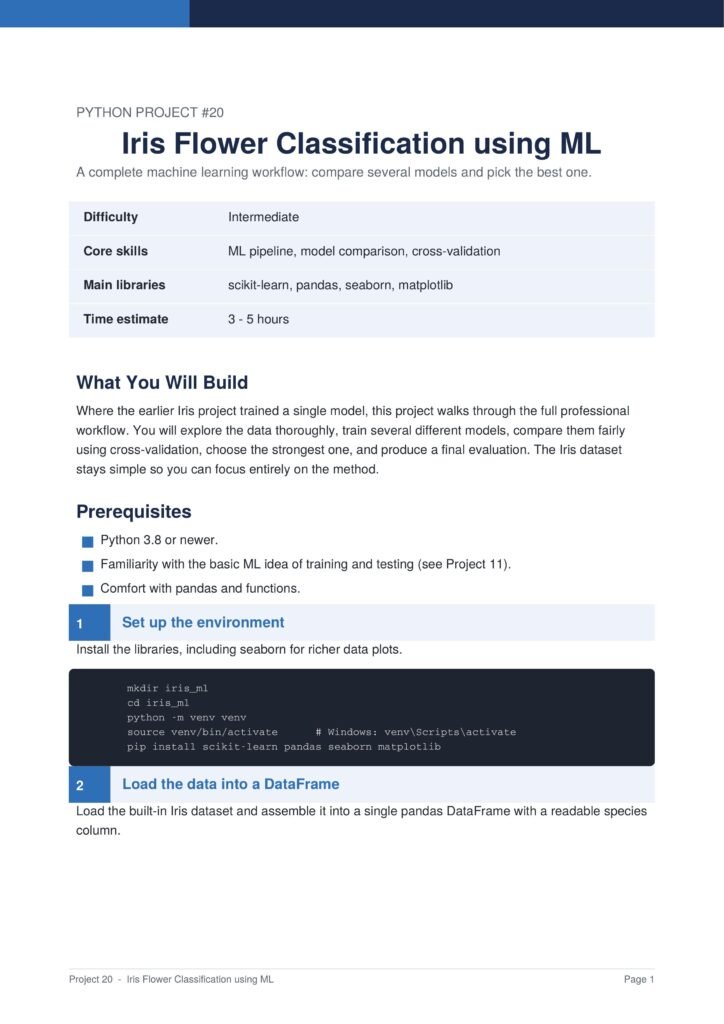
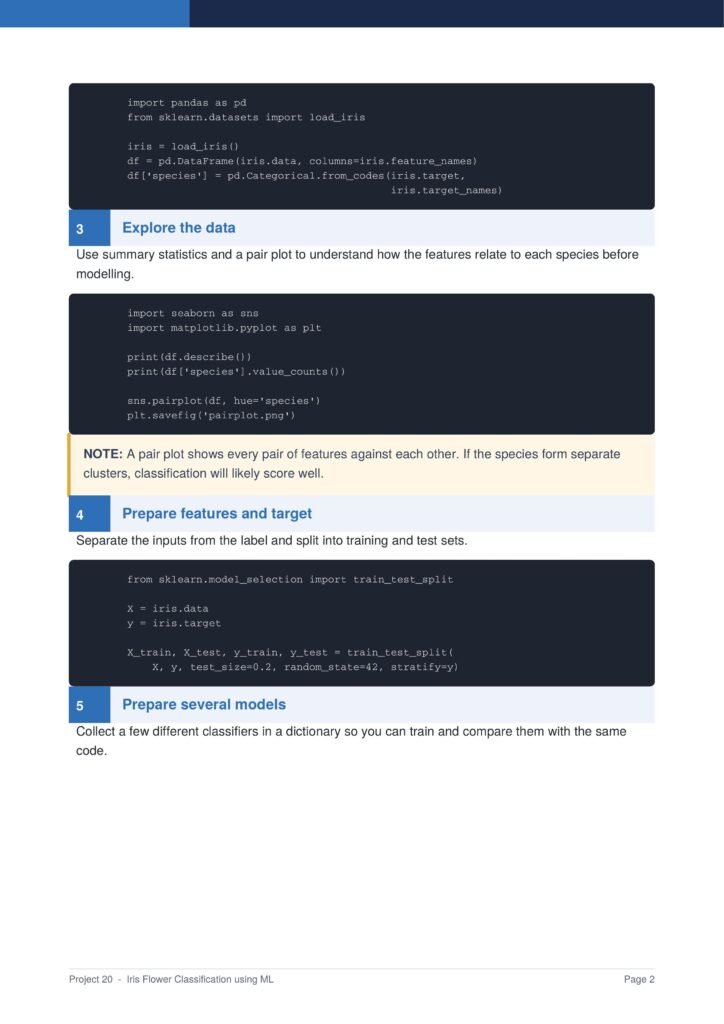
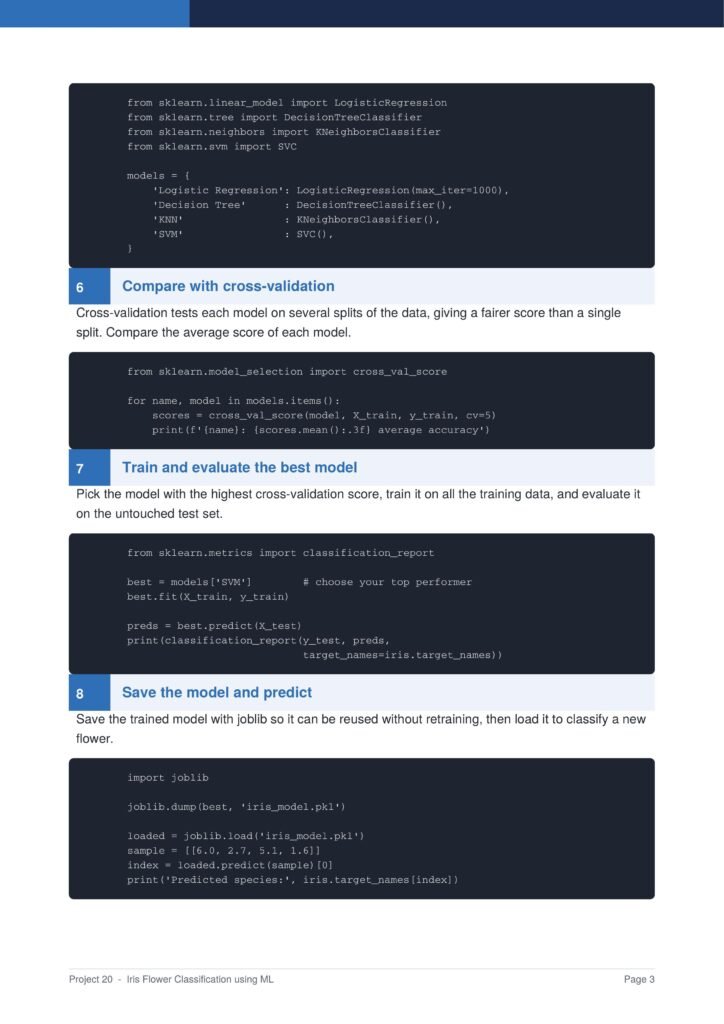

The guide trains several different classifiers and shows how to decide which one performs best on the data.
The Content Of The Document
a. Loading and Exploring the Data
The guide begins by loading the Iris dataset and exploring it with summary statistics and clear visualizations.
b. Preparing the Data
You learn how to separate the features from the labels and split the data into training and test sets.
c. Training Multiple Models
The document shows how to train several classifiers such as Logistic Regression, K-Nearest Neighbours, and a Decision Tree.
d. Comparing Performance
You learn how to measure the accuracy of each model and compare them fairly to find the strongest one.
e. Evaluating the Best Model
The guide shows how to study the best model with a confusion matrix and a detailed classification report.
Why This Document
a. Teaches Model Comparison
This document is valuable because it teaches model comparison, a key skill for choosing the right algorithm for a problem.
b. Deeper Than a First Project
The guide goes deeper than a basic first project, introducing evaluation tools that professionals rely on every day.
c. Builds Real Confidence
By working with several algorithms at once, you build real confidence in the machine learning workflow.
Conclusion
The “Iris Flower Classification using ML” project is a thorough introduction to building and comparing machine learning models. By following the guide, you learn how to explore data, prepare it, train multiple classifiers, compare their performance, and evaluate the best one. The result is real, practical data science experience. If you want a project that deepens your machine learning skills, this clear step-by-step guide is an excellent choice.
Download From The Below Link
To start building your own iris flower classification project today, you can download the Iris Flower Classification using ML PDF guide and follow every step at your own pace. Happy coding!