In the rapidly growing world of artificial intelligence, Python has become the go-to language for building intelligent applications that understand human language. One of the most practical and beginner-friendly ways to step into this field is through sentiment analysis, a technique that teaches a computer to recognize emotion in text.
This guide, titled “Sentiment Analyser ML Project,” is a complete step-by-step resource that walks you through building your own machine learning model capable of classifying any sentence as positive, negative, or neutral.


Overview of The Document
The Sentiment Analyser ML Project guide is carefully designed for learners who want a real, hands-on introduction to machine learning and natural language processing. Whether you are a student building your first portfolio project or a developer expanding your skill set, this document gives you a clear and structured path to follow.
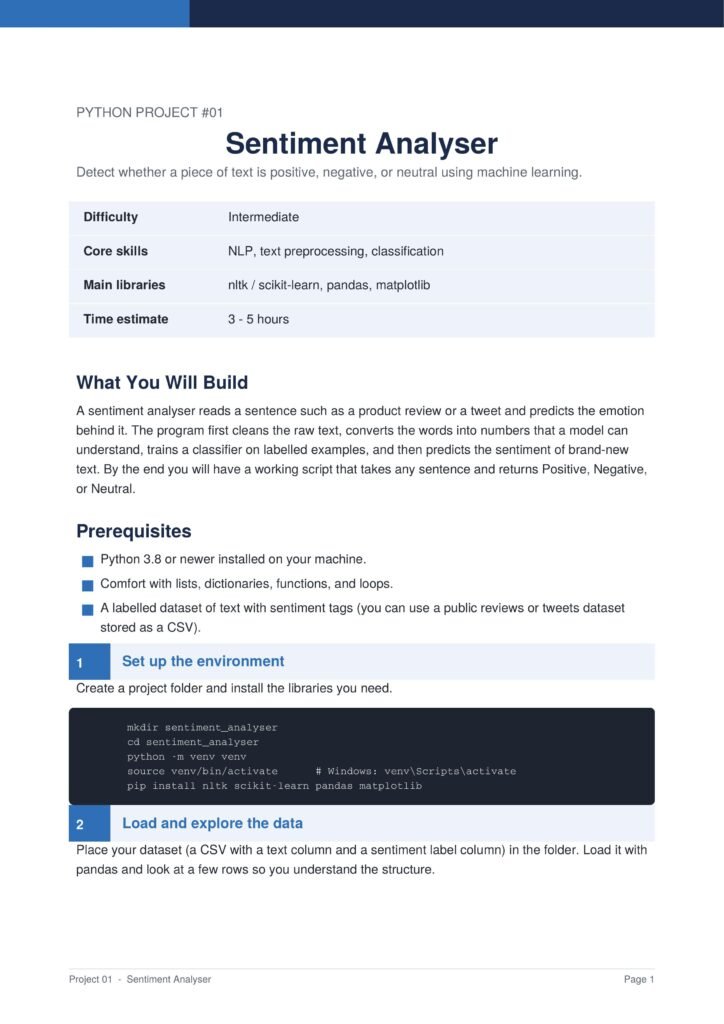
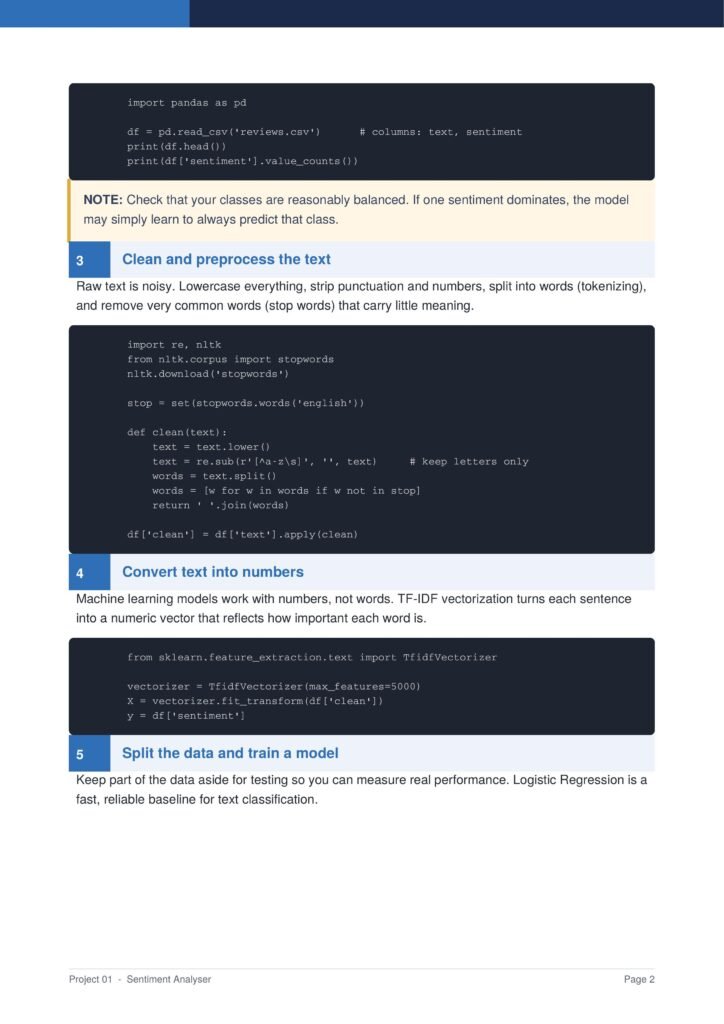
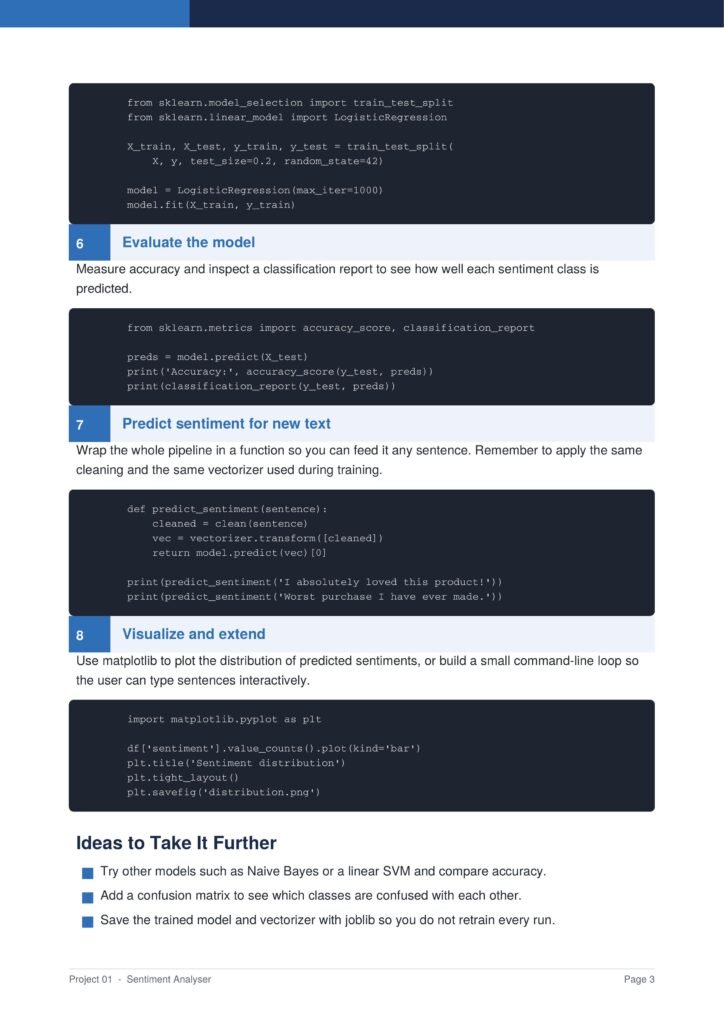

Written in plain, accessible English, the guide is organized into eight focused steps. Each step covers a single concept, opening with a clear explanation and followed by a ready-to-use code block, so you always understand both what to type and why it matters.
The Content Of The Document
a. Environment Setup and Data Loading
The guide begins by setting up a Python virtual environment and installing the core libraries, including scikit-learn, pandas, and matplotlib. You then load a labelled dataset of text and explore its structure to understand the balance of sentiment classes.
b. Text Cleaning and Preprocessing
A key part of the document explains text preprocessing in detail, showing how to lowercase text, strip punctuation and numbers, tokenize words, and remove common stop words that add noise to the data.
c. Feature Extraction with TF-IDF
The guide shows how to convert words into numbers using TF-IDF vectorization, a technique that reflects how important each word is across the entire dataset, making the text understandable to a machine learning model.
d. Model Training and Evaluation
Readers learn how to split data into training and test sets, train a Logistic Regression classifier, and evaluate its performance using accuracy scores and a detailed classification report.
e. Prediction and Visualization
The final steps wrap the entire pipeline into a reusable prediction function and visualize the results with a simple chart, so you finish with a working program that classifies any sentence you give it.
Why This Document
a. Explains the Reasoning
This document stands out because it does not just hand you code. It explains the reasoning behind every decision, so you finish with genuine understanding rather than a script you cannot adapt to new problems.
b. Practical and Project-Based
The guide is completely practical. By the end you have a real working program, and the structure mirrors a professional machine learning workflow, building habits that carry directly into more advanced projects.
c. Perfect for Portfolios
For students, this is an excellent portfolio piece that demonstrates real data science skills. For developers, it is a quick and reliable refresher on the full natural language processing pipeline.
Conclusion
The “Sentiment Analyser ML Project” is more than a simple exercise. It is a complete introduction to natural language processing and machine learning, packaged in a clear, step-by-step format that respects your time and builds real understanding. By following the guide, you gain practical experience with data cleaning, feature engineering, model training, and evaluation, all of which are foundational skills in modern data science. If you have been looking for a meaningful first machine learning project, this one delivers both the structure and the depth you need to succeed.
Download From The Below Link
To start building your own sentiment classifier today, you can download the Sentiment Analyser ML Project PDF guide and follow every step at your own pace. Happy coding!