Monday, May 18, 2026
  • About
  • Advertise
  • Careers
  • Contact
Connect 4 Programming
  • Home
  • Python
  • Java
  • SQL
  • JavaScript
  • HTML
  • Data Structure
  • GIT
  • OOP
  • Interview Questions
  • Login
No Result
View All Result
Connect 4 Prog
Home Python

Iris Flower Detector Py Project Guide

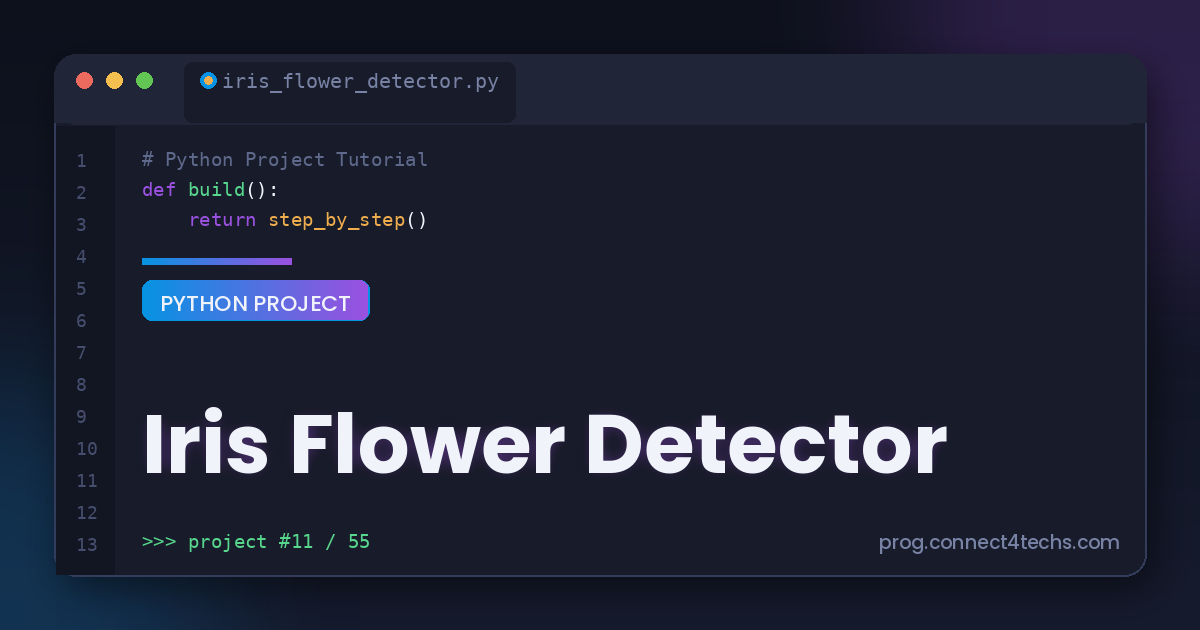
Iris Flower Detector Python project tutorial

#image_title

The Iris dataset is the most famous starting point in machine learning, and classifying its flowers is the perfect first step into this field with Python. It teaches the full machine learning workflow on clean, simple data.

This guide, titled “Iris Flower Detector,” walks you step by step through building a model that classifies iris flowers into three species from their petal and sepal measurements.

Related posts

Contact Book Application Python project tutorial

Contact Book Application Py Project Guide

May 18, 2026
Typing Speed Test Python project tutorial

Typing Speed Test Py Project Guide

May 18, 2026

Overview of The Document

The Iris Flower Detector guide is a beginner-to-intermediate tutorial that takes you from an empty file to a working classifier. It is written in clear, plain English and organized into eight focused steps.
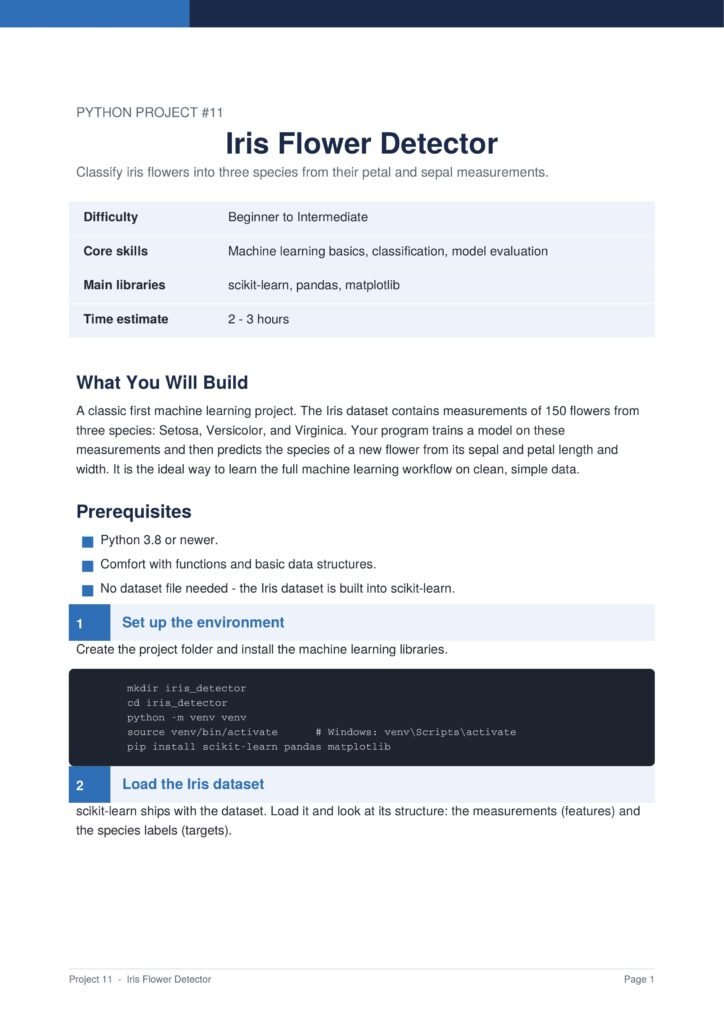
Intro slide for 'Iris Flower Detector' project: title, subtitle, and a light blue table listing difficulty, core skills, main libraries, and time estimate.
Iris Flower Detector Py Project Guide 1
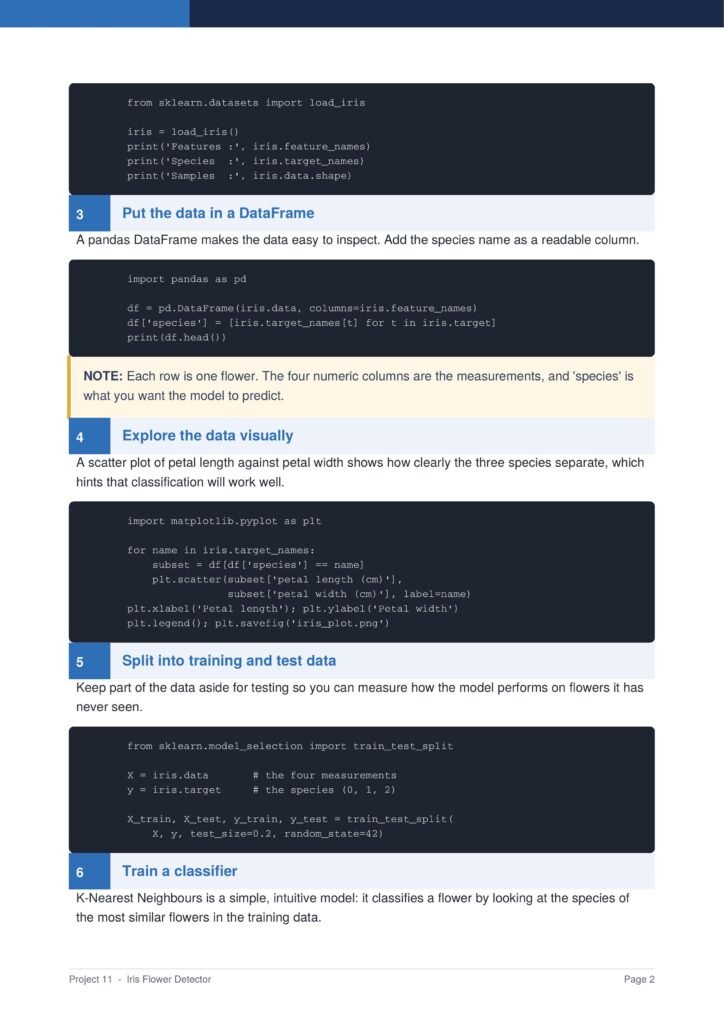
Screenshot of a tutorial page showing steps 3–6: code blocks for loading iris data, creating a DataFrame, notes on data, and plotting, with section titles 'Put the data in a DataFrame', 'Explore the data visually', 'Split into training and test data', and 'Train a classifier'.
Iris Flower Detector Py Project Guide 2
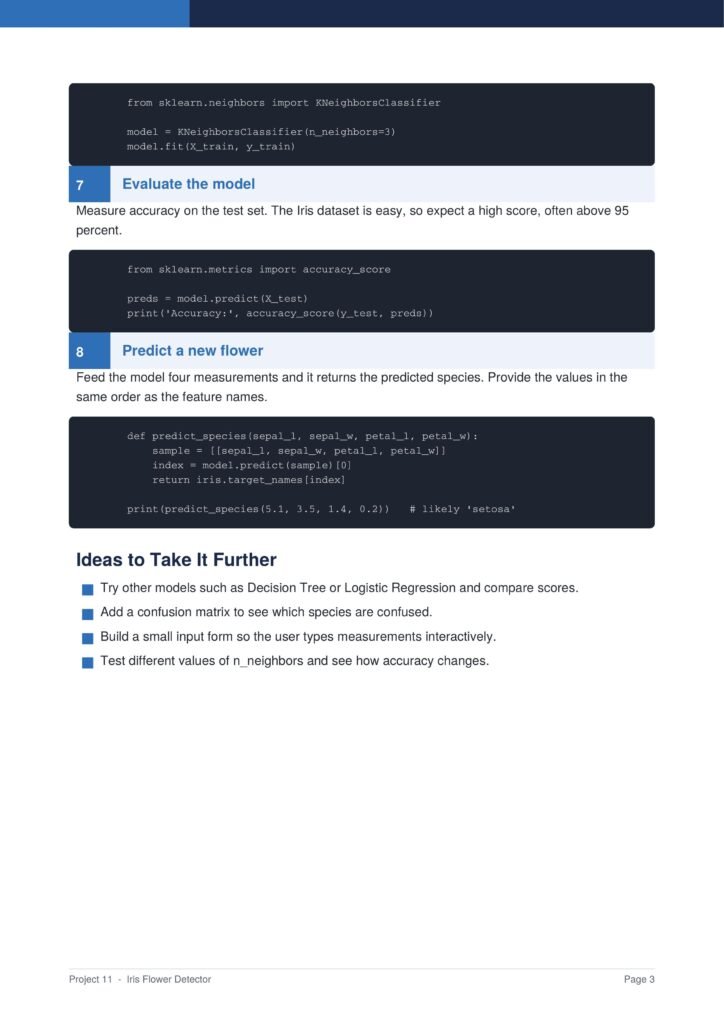
Tutorial page showing code blocks for training, evaluating, and predicting iris flower species, with sections 'Evaluate the model' and 'Predict a new flower'
Iris Flower Detector Py Project Guide 3

Because the Iris dataset is built into scikit-learn, no data file is needed, letting you focus entirely on learning the machine learning method.

The Content Of The Document

a. Loading the Iris Dataset

The guide begins by loading the built-in Iris dataset and exploring its measurements and species labels.

b. Exploring the Data

You learn how to place the data in a pandas DataFrame and create a scatter plot that shows how clearly the species separate.

c. Splitting the Data

The document explains how to split the data into training and test sets so you can measure real performance fairly.

d. Training a Classifier

You learn how to train a K-Nearest Neighbours model, an intuitive algorithm that classifies flowers by similarity to known examples.

e. Evaluating and Predicting

The guide shows how to measure accuracy on the test set and predict the species of a brand-new flower from its measurements.

Why This Document

a. The Ideal First ML Project

This document is valuable because the Iris dataset is the ideal first machine learning project, simple enough to focus on the method itself.

b. Covers the Full Workflow

The guide covers the complete workflow from loading data to making predictions, building habits you will reuse in every future model.

c. Clear and Practical

Every step is explained before the code is shown, so you understand the reasoning behind each part of the machine learning process.

Conclusion

The “Iris Flower Detector” project is the perfect introduction to machine learning. By following the guide, you learn how to load data, explore it visually, split it, train a classifier, and make predictions. The result is a working model and a clear understanding of the machine learning workflow. If you want a confident first step into data science, this clear step-by-step guide is an excellent choice.

Download From The Below Link

To start building your own iris flower classifier today, you can download the Iris Flower Detector PDF guide and follow every step at your own pace. Happy coding!
author avatar
Ahmad Hussain
See Full Bio

Related Posts

71 Python Projects with References and Source Code
Python

71 Python Projects with References and Source Code

March 28, 2025
OOPS in Python Handwritten Notes
OOP

OOPS in Python Handwritten Notes

March 28, 2025
Python Programming and SQL PDF
Python

Python Programming and SQL PDF

March 28, 2025
80 Questions To Master Python PDF
Python

80 Questions To Master Python PDF

March 28, 2025
Basic Python Programs
Python

Basic Python Programs Handwritten PDF

March 28, 2025
Python Notes Handwritten
Python

Python Notes Handwritten PDF

March 28, 2025

Leave a Reply Cancel reply

Your email address will not be published. Required fields are marked *

POPULAR NEWS

  • 71 Python Projects with References and Source Code

    71 Python Projects with References and Source Code

    0 shares
    Share 0 Tweet 0
  • OOPS in Python Handwritten Notes

    10 shares
    Share 0 Tweet 0
  • Most Asked JavaScript Interview (100 Q&A) PDF

    0 shares
    Share 0 Tweet 0
  • Most Asked Java Interview (100 Q&A) PDF

    0 shares
    Share 0 Tweet 0
  • Top 50 Java Interview Questions and Answers PDF

    0 shares
    Share 0 Tweet 0
Connect 4 Programming

We bring you the best Premium WordPress Themes that perfect for news, magazine, personal blog, etc.

Follow us on social media:

Recent News

  • Sentiment Analyser Py Project Guide
  • Pin Your Note Py Project Guide
  • Notification App Py Project Guide

Category

  • Data Structure
  • GIT
  • HTML
  • Interview Questions
  • Java
  • JavaScript
  • OOP
  • Programming
  • Py
  • Python
  • SQL
  • Uncategorized

Recent News

Sentiment Analyser ML Project Python tutorial

Sentiment Analyser Py Project Guide

May 18, 2026
Pin Your Note Python project tutorial

Pin Your Note Py Project Guide

May 18, 2026
  • About
  • Advertise
  • Careers
  • Contact

Welcome Back!

Login to your account below

Forgotten Password?

Retrieve your password

Please enter your username or email address to reset your password.

Log In

Add New Playlist

No Result
View All Result
  • Home
  • Python
  • Java
  • SQL
  • JavaScript
  • HTML
  • Data Structure
  • GIT
  • OOP
  • Interview Questions